Yes, you can usually bring a power bank on a plane in your cabin baggage. It cannot go in checked luggage. A healthy, clearly labeled unit of 100 watt-hours (Wh) or less is the easiest starting point, but your airline can restrict quantity, storage and use.

For travel in October 2026, check the carrier rather than relying on an old battery allowance. Southwest allows one power bank, while Singapore Airlines permits two. Being allowed to carry a charger also doesn’t mean you can use it during the flight.
The practical choice: bring only the power you need, keep the original rating readable, and pack the charger where you can reach it. Check every operating airline, including connections. Remove it before handing over any bag that will travel in the hold.
Power bank on a plane: capacity and baggage rules
The FAA’s battery guidance permits ordinary lithium-ion spares up to 100 Wh in cabin baggage. Larger units above 100 Wh through 160 Wh need airline approval. The FAA warns that airlines can set stricter limits specifically for power banks.
| Power bank rating | What to do before travel | Checked bag? |
|---|---|---|
| 100 Wh or less | Check the operating carrier’s number, storage and usage rules | No |
| Above 100 Wh through 160 Wh | Get explicit approval where the airline permits this category; some don’t | No |
| Above 160 Wh | Not within the ordinary passenger power bank allowance | No |
| No readable rating | Resolve the identification problem before leaving; don’t guess the capacity | No |
These bands concern each unit, not the combined energy of everything in your backpack. Two hypothetical 74 Wh banks are each below 100 Wh. A single 148 Wh bank occupies a different approval category, even though the total energy is identical.
A permitted battery doesn’t create an extra baggage allowance. Your pouch still belongs inside a permitted cabin bag. Use the airline baggage guide directory to check the bag itself.
The 2026 change: two banks is a limit, not a promise
ICAO introduced a limit of two power banks per passenger effective March 27, 2026. Its specifications also prohibit recharging the power bank aboard the aircraft. They recommend against using one to recharge a phone or another device.
The ICAO explanation of the change separates power banks from other spare batteries. Its examples still allow banks above 100 Wh through 160 Wh with operator approval. They never allow more than two power banks in total.
Implementation depends on the applicable state rules and the airline. The FAA’s general battery page still lists no numerical limit for most small personal batteries. That general wording doesn’t override an airline’s power bank policy.
Don’t interpret a rule allowing numerous spare camera batteries as permission to carry that many portable chargers. They are now separate categories in the ICAO instructions. Also, two isn’t an entitlement when your carrier permits only one.
Flying in 2027? Recheck before buying a large laptop charger. IATA’s March 2026 operator guidance says the approval provision for power banks above 100 Wh won’t continue into its 2027 edition.
That future change doesn’t make every larger power bank automatically forbidden on every October 2026 flight.
The distinction appears in IATA’s 2026 operator guidance. Its explanatory text and summary table differ on larger banks. For an actual journey, get the operating airline’s current answer for your model and travel date.
How to check mAh, volts and watt-hours
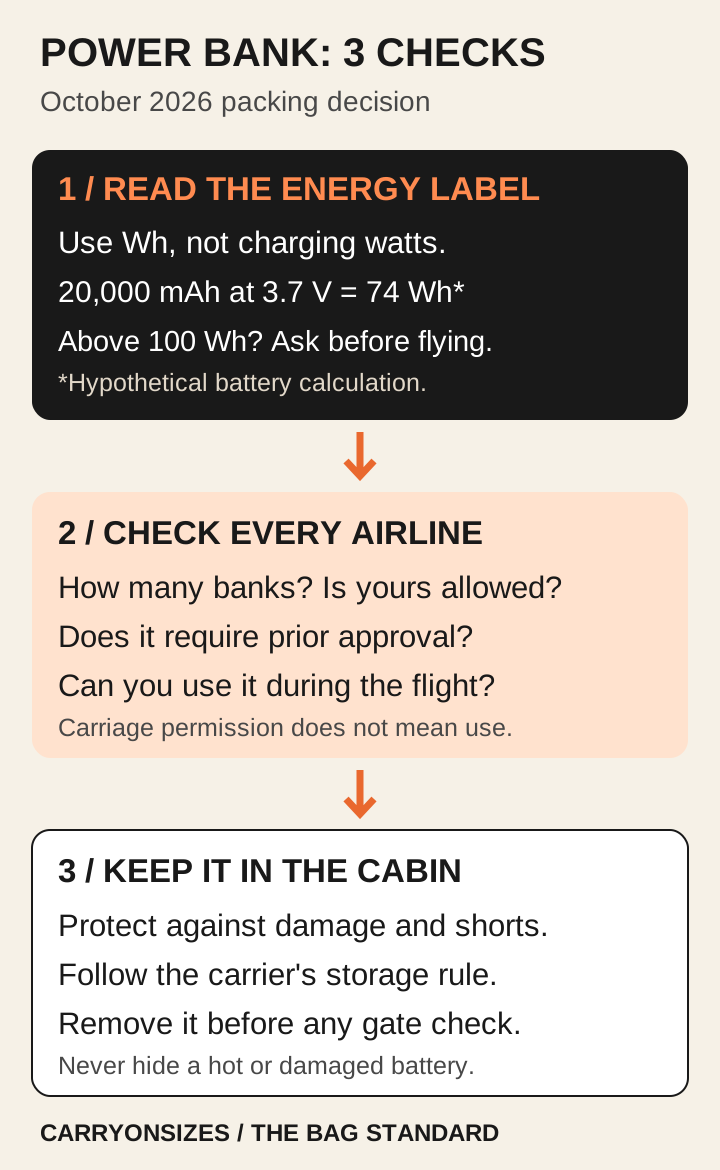
Look for the printed Wh figure first. A label might show 74 Wh alongside 20,000 mAh and 3.7 V. Those figures describe stored energy and battery capacity, not the speed at which the bank charges a laptop.
If Wh isn’t printed, the conversion is Wh = (mAh / 1,000) x nominal battery voltage. Use the battery’s own nominal voltage. Don’t substitute the USB output voltage just because it’s easier to find.
| Hypothetical battery label | Calculation | Result |
|---|---|---|
| 10,000 mAh at 3.7 V | 10 x 3.7 | 37 Wh |
| 20,000 mAh at 3.7 V | 20 x 3.7 | 74 Wh |
| 26,800 mAh at 3.7 V | 26.8 x 3.7 | 99.16 Wh |
| 27,600 mAh at 3.6 V | 27.6 x 3.6 | 99.36 Wh |
| 30,000 mAh at 3.7 V | 30 x 3.7 | 111 Wh |
These are calculated examples, not declarations that every product with those mAh figures has that rating. The 27,600 mAh example is below 100 Wh because its assumed voltage differs. That is why a universal cutoff such as 27,000 mAh can mislead.
Also separate W from Wh. A 140 W output label describes charging power, while 99 Wh describes stored energy. A high output number doesn’t by itself put the battery above the airline’s energy ceiling.
If several voltages appear, use the manufacturer’s battery specification for the exact model. Save that specification and a photo of the intact label. Supporting documents help identify a unit; they don’t guarantee acceptance of an unreadable or noncompliant bank.
Airline examples: carry, use and recharge are different
Read all three questions separately: may it travel, may it charge your device, and may the aircraft recharge it? The table below uses current published airline policies. It illustrates the differences rather than covering every airline.
| Operating airline | Carriage limit | Onboard treatment |
|---|---|---|
| Southwest | One bank, no more than 100 Wh | No overhead storage or onboard recharging; keep visible when using |
| Emirates | One bank, maximum 100 Wh, clearly visible capacity rating | Cannot charge devices or be recharged; no overhead storage |
| Singapore Airlines | Two banks; up to 100 Wh without approval, above 100 through 160 Wh with prior approval | No use or recharging during flight; no overhead storage |
Southwest: one bank and visible use
Southwest’s current requirements limit each customer to one bank from April 20, 2026. It should stay in a personal item under the seat. If used, it must remain visible rather than hidden inside a bag.
That means bringing two small chargers can fail even if both fall well below 100 Wh. Consolidate your travel kit before leaving home. Our Southwest baggage guide covers the surrounding bag allowance.
Emirates: carriage without onboard use
Emirates’ dangerous goods policy allows one bank with a maximum capacity of 100 Wh. It prohibits charging other devices from it and recharging it from aircraft power. Keep it accessible, outside the overhead compartment.
An earlier announcement used the wording “under 100” rather than “maximum 100.” The current carriage policy uses maximum 100 Wh. If your device sits exactly on that boundary, keep the original rating clear and reconfirm before travel.
Singapore Airlines: prior approval for larger units
The Singapore Airlines advisory effective April 15, 2026 permits two banks. Units above 100 Wh through 160 Wh require prior approval. Neither using nor recharging power banks is allowed during the flight.
For an approval request, its battery restrictions page asks for a rating photo and documentary proof of the required UN 38.3 testing. Contact the airline before the airport. A retailer’s “flight approved” badge isn’t that approval.
International connections can change the answer
List the company operating each flight, not just the airline selling the ticket. Then check the departure country, any domestic connection and your return journey. One carrier’s written approval cannot establish another carrier’s permission.
Mainland China domestic flights: the CCC mark
CAAC prohibits power banks without clear CCC markings on domestic flights from June 28, 2025. Recalled models or batches are also prohibited. Its official notice expressly describes domestic flights.
A small, familiar brand can still fail that requirement. “Made in China” is not the same marking as CCC certification. A domestic connection within mainland China matters even when your journey began abroad.
For example, imagine flying internationally to Beijing, then taking a separate domestic flight to Shanghai. Check the domestic requirement before packing at home. Passing the first airport doesn’t establish compliance for the next flight.
Don’t expand that notice into a claim that every international flight worldwide requires CCC. Equally, don’t assume an international itinerary removes all local screening or carrier conditions. Confirm the actual route if the marking or transfer requirements are unclear.
Where to pack a power bank on a plane
A personal item counts as cabin baggage for this purpose. You don’t need an overhead suitcase to carry a charger. A protected pouch in your underseat bag is often the simplest arrangement, subject to the airline’s storage directions.
Under the US passenger battery exception, spare batteries require protection from short circuit. Keep exposed terminals away from keys, coins and other metal. A protective pouch or suitable case helps separate the battery and prevent damage.
- Unplug the bank before packing, unless your carrier expressly allows its use in that situation.
- Give it a dedicated place that you can reach without emptying your bag.
- Keep the casing and label visible enough for identification when asked.
- Put the pouch in the bag that will remain with you, rather than a roller likely to be checked.
- Follow crew instructions about where it must be stored aboard your particular aircraft.
Keep charging cables beside the charger rather than wound tightly around its ports. Avoid a packing arrangement that crushes it beneath heavy equipment. A small organizer should make access easier, not conceal a hot or damaged battery.
If choosing a smaller cabin bag, our underseat bag guide explains fit considerations. Battery compliance and baggage dimensions are separate checks. A bag with a charging port still needs its battery assessed.
If your carry-on is checked at the gate
Remove the power bank before handing over the bag, including a complimentary gate check. The FAA’s gate check reminder specifically includes portable chargers and spare lithium batteries. Keep them with you in the aircraft cabin.
If you’ve already surrendered the bag, tell airline staff immediately that it contains a power bank. Identify the bag and explain where the unit is. Don’t stay quiet because boarding is busy or assume a free gate check changes the battery rule.
Damage, recalls and a charger that gets hot
Leave a swollen, damaged or recalled bank out of your travel kit. Familiarity isn’t proof that the unit remains safe. Check the exact model and serial number against the manufacturer’s recall process.
The CPSC’s Anker PowerCore 10000 recall illustrates why the serial number matters. Its notice directs owners to check their unit and follow the recall remedy. That notice doesn’t mean every Anker charger is recalled.
If a bank becomes unusually hot, expands, smokes or burns aboard the aircraft, notify the crew immediately. Don’t hide it in a bag or move it into the overhead compartment. Let the crew direct the response.
If a device slips into the seat mechanism, tell the crew before adjusting the seat. Don’t try to free it by moving powered seat parts. A delayed arrival is easier to manage than a battery damaged inside the seat.
A useful check before leaving home
For a power bank on a plane, save a small evidence pack: the model number, original rating photo and airline policy. Add written approval if your unit needs it. Keep an offline copy so a poor airport connection doesn’t hold up the conversation.
If requesting permission, send the airline your flight dates, operating flight numbers, model, Wh rating and quantity. Ask separately about carriage, storage and use. Keep the reply with the booking rather than relying on a general chat message.
For travel on more than one airline, use the strictest applicable combination when planning your kit. A two bank allowance on the long flight won’t help if the connecting airline allows one. Likewise, permission to use it on one leg doesn’t transfer to the next.
For the rest of your security packing, check liquid container limits separately. Neither a battery approval nor an airline bag allowance determines what you can take through liquid screening.
Power bank questions before you fly
Can I bring a 20,000 mAh power bank on a plane?
Usually, if its verified Wh rating meets your airline’s limit and it travels in cabin baggage. At a hypothetical nominal voltage of 3.7 V, 20,000 mAh equals 74 Wh. Check quantity, condition, labeling and route rules as well.
Is a 30,000 mAh power bank allowed?
Check the printed Wh rating and nominal voltage. A hypothetical 30,000 mAh bank at 3.7 V equals 111 Wh, above the ordinary 100 Wh band. It needs an airline that permits this category and grants approval; some carriers reject it.
Can I put a power bank in checked luggage if it is switched off?
No. Switching it off doesn’t make a power bank acceptable in checked luggage. Keep it in the cabin and remove it before any gate check.
Does a 100 W charging output mean my bank exceeds the limit?
No. Watts describe charging power, while watt-hours describe stored energy. Read the battery’s Wh rating or calculate it from its capacity and nominal voltage.
Can I charge my phone from a power bank during the flight?
Only if the operating airline permits it. Emirates and Singapore Airlines prohibit power bank use, while Southwest requires a bank to stay visible when used. Permission to carry it is separate from permission to use it.
Can I recharge the power bank from the aircraft USB port?
Don’t plan to do that. ICAO’s 2026 specifications prohibit recharging power banks aboard aircraft, and airlines can impose additional restrictions. Charge your travel equipment before boarding.