Air India baggage allowance gives Economy and Premium Economy passengers one cabin bag up to 7 kg, measuring 55 x 40 x 20 cm. Business and First Class allow 10 kg in that main bag. A separate small personal item can weigh up to 3 kg and must fit under the seat.

The checked allowance needs a closer look at your ticket. Domestic Economy can mean 15, 20 or 25 kg, with different piece limits. International Economy may use kilograms or a set number of bags, depending on your route and fare.
Air India baggage allowance: the cabin limits
| Bag | Maximum outside size | Weight and count |
|---|---|---|
| Economy or Premium Economy main bag | 55 x 40 x 20 cm; 115 cm total | One bag, up to 7 kg |
| Business or First main bag | 55 x 40 x 20 cm; 115 cm total | One bag, up to 10 kg |
| Small personal item | 40 x 30 x 20 cm; 90 cm total; must fit underseat | One qualifying item, up to 3 kg |
These are Air India’s rules, not Air India Express rules. Check the operating airline beneath each flight number before using them. Shared branding or a familiar booking website doesn’t make the allowances interchangeable.
Use centimeters when measuring. The airline’s published inch figures are rounded, so converting those back to centimeters can create confusion. The dimensions and weight in the current cabin baggage policy apply to both domestic and international Air India flights.
A laptop bag is allowed, but its weight matters
A small laptop bag can be your additional personal item. A handbag or camera bag can fill that role instead. The allowance isn’t a laptop bag plus a handbag plus a third shopping tote.
Keep that item within its own 3 kg limit. A large work backpack can reach that weight before you’ve added toiletries or clothes. Include the laptop charger, power bank and bag itself when weighing it.
Hypothetical packing example: your Economy roller weighs 8.2 kg and your small laptop bag weighs 2 kg. Moving 1.2 kg between them makes the roller 7 kg, but leaves the laptop bag at 3.2 kg. You still need to remove or relocate at least 0.2 kg to meet both limits.
The arithmetic matters more than the combined total. You don’t receive a freely interchangeable 10 kg cabin budget in Economy. For a lighter second bag, compare the packed dimensions in our underseat bag guide.
Measure the loaded bag, including the awkward parts
Pack first, close every zip, then measure the outermost points. Include wheels, fixed handles and stuffed pockets. An expansion panel can make an otherwise suitable case too deep.
A case measuring 55 x 35 x 25 cm totals 115 cm. It still exceeds the 20 cm depth limit. Passing the total doesn’t cancel an individual dimension.
Check the maker’s overall measurements before buying a replacement. Some listings emphasize the case shell instead. Our carry-on luggage buying guide explains how to compare useful specifications.
The 12 kg cabin figure is a paid ceiling
Air India’s policy permits a cabin bag up to 12 kg after applicable excess hand baggage charges. It lists INR 3,000 for domestic travel and USD 75 for international travel. Those figures do not replace the free 7 kg or 10 kg allowance.
The policy also links calculation of the free allowance to applicable cabin and checked baggage entitlement. Ask how that applies to your booking before relying on unused hold weight. Do not assume an empty checked allowance automatically authorizes a heavier roller.
A bag over 12 kg must be checked, with applicable excess baggage charges. Paying a weight charge also doesn’t make an oversized bag meet the cabin dimensions. Resolve both problems before reaching the gate.
Being a Maharaja Club or Star Alliance member doesn’t entitle you to a second main cabin bag. Business Class still has a single main cabin bag limit. Any checked baggage status benefit is a separate allowance.
Domestic checked bags: weight is only half the answer
The following table covers standard Air India operated domestic flights. Your issued ticket remains the practical starting point, especially after a booking change. An international connection can change what applies to the domestic sector.
| Cabin and fare | Included checked weight |
|---|---|
| Economy Basic, where offered | 15 kg |
| Economy Value | 15 kg |
| Economy Classic | 20 kg |
| Economy Flex | 25 kg |
| Premium Economy Value / Flex | 15 kg / 25 kg |
| Business Value / Flex | 30 kg / 40 kg |
| First | 40 kg |
The Basic fare was announced on June 16, 2026, as a trial on selected domestic routes. It includes 15 kg checked baggage and 7 kg cabin baggage. Don’t assume every domestic departure offers it.
A free checked allowance below 25 kg permits one piece; an allowance of 25 kg or more permits two. This is easy to miss when comparing fares. A 20 kg Classic allowance isn’t automatically permission to check two 10 kg cases.
If you need two checked pieces, compare the actual Flex fare difference against the baggage quote. Buying extra weight may not solve an extra bag problem by itself. Make sure any purchase confirms both the weight and number of bags.
No single ordinary checked bag may weigh more than 32 kg across the network. A 40 kg allowance therefore needs at least two bags. Packing all 40 kg into one suitcase won’t work.
International checked allowance: read the unit on your ticket
Air India baggage allowance uses two systems internationally. A weight allowance gives a total in kilograms. A piece allowance specifies how many bags you can check and the limit for each.
| Destination group | Value | Classic | Flex |
|---|---|---|---|
| Europe | 1 x 23 kg | 2 x 23 kg | 2 x 23 kg |
| United States and Canada | 1 x 23 kg | 2 x 23 kg | 2 x 23 kg |
| Gulf and Middle East | 25 kg total | 30 kg total | 35 kg total |
| Australia and New Zealand | 25 kg total | 30 kg total | 35 kg total |
These selected rows are not a worldwide Economy promise. Check your direction, fare and any special entitlement in the checked baggage table for your route. On its listed piece routes, Premium Economy generally shows two 23 kg bags, while Business shows two 32 kg bags.
The page also retains an older Newark note stating one 23 kg Economy piece. That conflicts with reading its broad US fare table as unconditional. For Newark, get the baggage line on your particular ticket confirmed before planning two free bags.
An allowance of two pieces at 23 kg each isn’t permission for one 30 kg bag and another weighing 16 kg. The first bag exceeds its included weight. Rebalance them or obtain the applicable overweight quote.
Two large checked cases can exceed the combined size limit
For domestic Economy and Premium Economy, each piece must stay within 158 cm when length, width and height are added. The two pieces together must stay within 272 cm. The international table lists a tighter combined figure of 271 cm.
For a mixed journey, plan within 271 cm unless Air India confirms a different applicable allowance. Business and First list 158 cm per piece. These are added measurements, not a suitcase’s height alone.
Hypothetical size example: one checked case totals 150 cm and the second totals 125 cm. Each is below 158 cm, but together they total 275 cm. That exceeds both published Economy combined limits.
A smaller second case totaling 120 cm would bring that example to 270 cm. Measure both packed cases before deciding that two individually compliant bags are enough. Weight and piece count need their own checks too.
A packing worksheet that keeps the limits separate
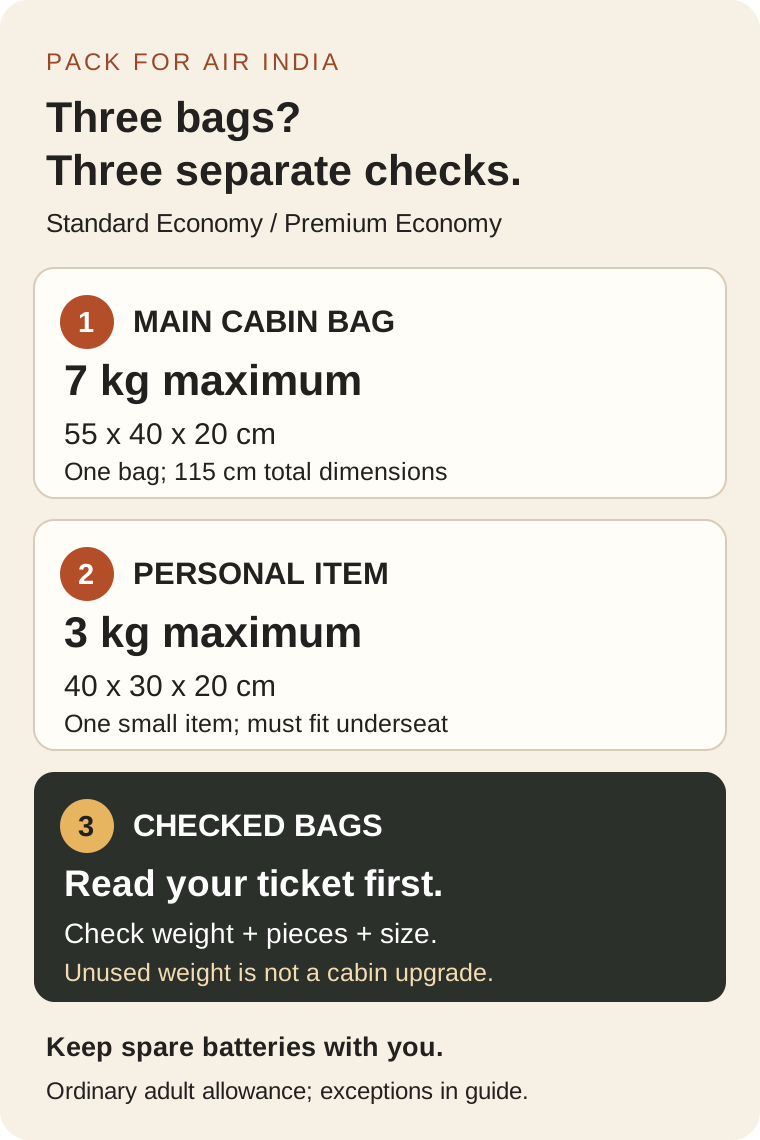
Start with the ticket’s checked line, then write down each bag’s packed weight beside it. For piece allowances, record every piece separately. For Economy cabin bags, keep separate entries for the main bag and personal item.
This catches the common packing errors before an airport scale does. It also shows which purchase you actually need: weight, an additional piece or an oversized item arrangement. Keep the receipt with your booking, rather than relying on a payment notification alone.
Extra baggage fees and when to buy
Use the official excess baggage schedule to distinguish extra weight, an extra piece and oversize charges. A heavier additional bag can involve more than one category. The airport rates below are useful comparisons, not universal prepaid prices.
| Situation | Published rate and qualification |
|---|---|
| Extra checked weight within India | INR 800 per kg, excluding applicable taxes |
| Extra piece up to 23 kg, India to USA | USD 240 per piece, excluding applicable taxes |
| Extra piece up to 23 kg, USA to India | USD 250 per piece, excluding applicable taxes |
| Oversized checked piece within India | INR 2,000 per item, excluding applicable taxes; other excess charges may apply |
Hypothetical domestic calculation: a 15 kg ticket and one 18 kg case create 3 kg of excess weight. At the published airport rate, that’s INR 2,400 before applicable taxes. This assumes the piece count and size already comply.
Prepayment can save up to 20%, but the discount isn’t guaranteed for every purchase. General additional weight or pieces can be prepaid up to two hours before departure. A single overweight piece, up to the 32 kg ceiling, has a purchase cutoff six hours before departure.
The advertised prepaid offer requires an eligible Air India ticket beginning 098. Interline and codeshare flights are excluded from that offer. Use the displayed booking quote for the actual price and check the return journey separately.
Connections, partners and loyalty benefits
On a single Air India domestic and international ticket, the international sector’s checked allowance applies. Separate domestic and international tickets can qualify when both flights are Air India operated and connect within 24 hours. Present both bookings and have the allowance confirmed before bag drop.
Do not extend that exception to a separate Air India Express flight or an arbitrary partner connection. For mixed carriers, checked baggage assessment can follow the applicable interline rules. A stopover may also trigger a new assessment.
Cabin baggage needs to meet the relevant operators’ restrictions throughout the trip. Check the Lufthansa cabin allowance or Singapore Airlines baggage rules if either operates a leg. An Air India flight number alone doesn’t settle that question.
Maharaja Club Silver adds 5 kg on eligible Air India flights using the weight system. Gold and Platinum list 20 kg extra on weight routes or one additional piece up to 23 kg on piece routes. Verify eligibility and whose allowance receives the benefit in the current tier benefits.
Don’t assign a status holder’s extra baggage to every traveler in the booking. Likewise, get permission before relying on pooling between passengers. Air India’s FAQ wording on pooling contains qualifications that shouldn’t be treated as unrestricted permission.
Traveling with children or assistance equipment
A child or infant traveling on a purchased seat falls under the published cabin allowance. A lap infant doesn’t automatically receive a separate full cabin roller allowance. For an accompanying infant, personal and infant cabin essentials may total up to 5 kg.
That 5 kg is a combined allowance for those items, not an extra 5 kg added to a 3 kg personal bag. Plan feeding bottles, food and the carrying tote together. Check screening requirements for the actual airport.
The dedicated checked policy lists one infant piece up to 10 kg across classes, plus an eligible collapsible stroller, carrycot or infant car seat. Another FAQ lists higher infant weights in premium cabins. Confirm the issued infant allowance before packing above 10 kg.
Assistive devices can travel free as additional baggage, subject to aircraft limitations. Arrange wheelchair carriage and battery details in advance. Ordinary power bank limits don’t describe every approved mobility battery arrangement.
If your cabin bag has to go into the hold
Make an essentials pouch that you can remove quickly. Keep travel documents, medication, valuables, your laptop and spare batteries with you. Ask where to collect the bag and retain the baggage receipt.
Air India’s restricted baggage rules place power banks and spare batteries in cabin baggage only. The standard published limit is two spares per person, with lithium-ion ratings no greater than 100 Wh. Protect each against short circuits and keep them out of overhead bins.
For Singapore departures, the policy expressly prohibits using or charging power banks onboard. Check the rating printed on the device before packing. Our power bank packing guide explains the markings and terminal protection.
A rechargeable laptop also needs attention before a bag is checked. Air India’s restrictions require its battery to be removed for checked carriage on departures from India. Keep a laptop with a nonremovable battery in the cabin and follow staff instructions.
Bag allowance doesn’t replace security screening. Review liquid container and screening rules for toiletries and connections. A sealed airport purchase can still create a problem when you pass through another checkpoint.
Air India baggage allowance questions
Can I bring a 7 kg cabin bag and a laptop bag?
Yes, in Economy and Premium Economy, a qualifying small laptop bag can accompany the 7 kg main cabin bag. Keep it within 40 x 30 x 20 cm and 3 kg, and make sure it fits underseat. It is one additional personal item, not an unlimited electronics allowance.
Does Premium Economy get a 10 kg cabin bag?
No. The standard main cabin allowance is 7 kg in both Economy and Premium Economy. Business and First Class receive 10 kg.
Can I split 20 kg of domestic checked baggage into two bags?
A standard free checked allowance below 25 kg permits one piece. Two bags totaling 20 kg can therefore exceed the included piece count. Confirm any purchase for an extra bag before travel.
Is 12 kg the free Air India cabin allowance?
No. Twelve kilograms is the published paid cabin ceiling under the excess hand baggage policy. The standard free main bag allowance remains 7 kg or 10 kg according to cabin.
Where do I confirm the allowance for my actual booking?
Check your latest issued e-ticket, including any baggage purchase or approved benefit. Air India’s baggage calculator can help with eligible Air India issued tickets. If its result differs from that ticket, the airline says the issued ticket prevails.