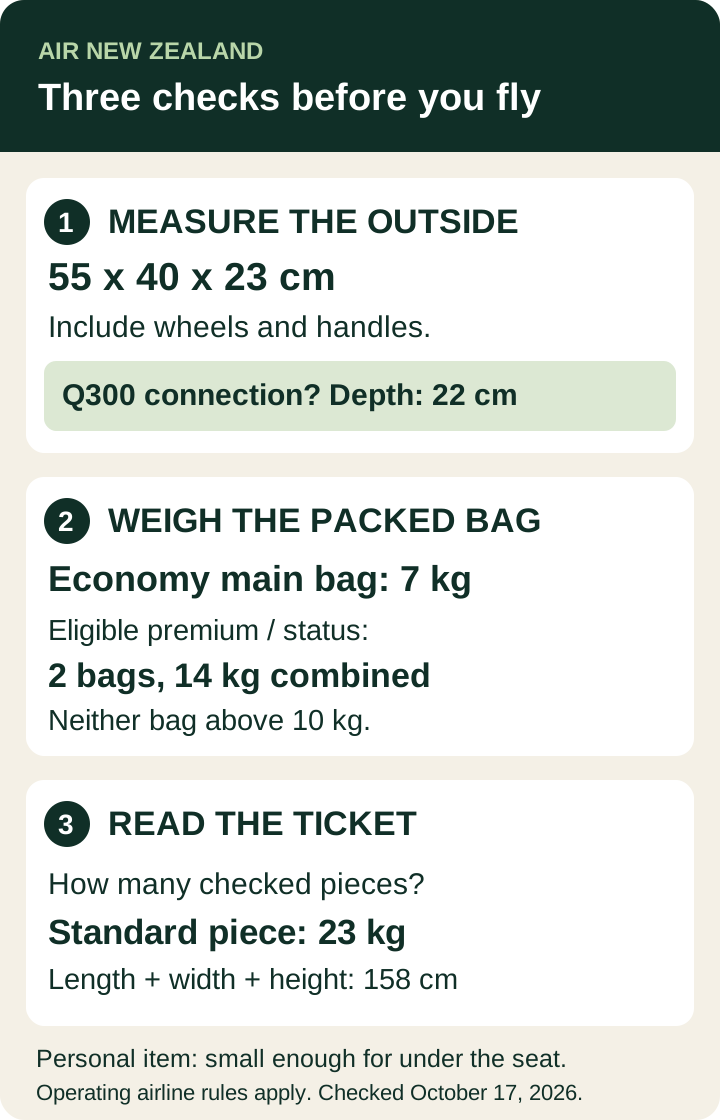
Air New Zealand baggage allowance starts with one cabin bag up to 7 kg plus one small personal item in Economy. The main bag must fit within 55 x 40 x 23 cm, including wheels and handles. A Q300 connection reduces that depth to 22 cm, so check the smallest aircraft before choosing your suitcase.

The other important number is the bag’s empty weight. A heavy roller can fit perfectly and still leave surprisingly little room for your clothes and electronics.
Air New Zealand baggage allowance at a glance
| What you are packing | Published rule | What to check |
|---|---|---|
| Economy main cabin bag | One bag, up to 7 kg (15 lb) | 55 x 40 x 23 cm, maximum 118 cm total |
| Q300 cabin bag | Depth no more than 22 cm | The smaller aircraft can change your bag choice |
| Small personal item | One additional small item | Must fit under the seat; a large laptop bag counts as your main bag |
| Eligible premium cabin or status | Two cabin bags, 14 kg combined; neither above 10 kg | Plus one small personal item; operator and eligibility matter |
| Standard checked piece | 23 kg (50 lb), 158 cm total dimensions | Number included depends on the ticket |
| Seat only fare | No standard checked bag | Cabin baggage is still included |
These cabin rules apply to flights operated by Air New Zealand. An NZ flight number on a partner’s aircraft does not automatically give you the same allowance.
Measure three sides, then check the Q300 exception
The cabin size limit is 55 x 40 x 23 cm, with a maximum total of 118 cm. Measure the packed exterior, including wheels, handles and filled pockets. Do not treat the total as permission to exceed an individual side.
For example, a hypothetical bag measuring 57 x 38 x 23 cm totals 118 cm. It still exceeds the published 55 cm side. Choose a bag that passes both checks.
On Q300 aircraft, the depth must be no more than 22 cm. That makes a rigid 55 x 40 x 23 cm roller a poor choice for a journey with a Q300 sector. Its depth cannot shrink just because the flight is short.
A soft bag may help if it genuinely measures within the limit once packed. Compression straps can reduce empty space, but they do not erase a hard frame or protruding wheel. Measure again after closing every zip.
Use the metric figures when comparing a close fit. Rounded inch labels on luggage listings can conceal a small but meaningful difference. Our carry-on luggage selection guide explains why overall dimensions matter more than a suitcase’s advertised size.
A personal item is extra space, not another full cabin bag
You can bring a small item as well as your main cabin bag. Suitable examples include a handbag, thin laptop, small camera or permitted duty-free goods. It must fit beneath the seat in front of you.
There is no published numerical personal item box on the main policy page. That does not make every backpack acceptable. The airline’s baggage help page specifically treats a large laptop bag as a main carry-on.
Think about function as well as appearance. A slim pouch holding your passport, glasses and medication is clearly different from a second packed travel backpack. If both bags contain most of your trip’s clothes, reconsider the smaller one’s role.
The published Economy wording gives the main carry-on a 7 kg limit and lists the small item separately. It does not state a separate personal item weight allowance. Avoid treating that silence as permission to move unlimited weight into a laptop bag.
For the least stressful setup, keep the main bag under its stated limit and the second item genuinely small. Our underseat bag guide helps distinguish a compact essentials bag from another suitcase.
The 14 kg allowance still has a 10 kg ceiling
Premium Economy, Business Premier and Business Premier Luxe travelers receive two cabin bags plus one small item. The same published benefit covers eligible connecting premium journeys and Koru Gold, Koru Platinum, Koru Black and Star Alliance Gold members.
The two main bags may weigh 14 kg together. Neither may exceed 10 kg, and each must meet the size requirements. This is not permission to bring a single 14 kg suitcase.
A hypothetical 9 kg roller and 5 kg second bag satisfy the weight arithmetic. An 11 kg roller and 3 kg second bag do not. Both combinations total 14 kg, but the second breaks the individual limit.
Keep proof of the qualifying cabin or membership available. Paid Koru Club membership is not the same label as Koru Gold status. The airline names specific tiers in its current cabin baggage policy.
Partner connections need a separate check. In particular, do not assume your premium cabin allowance transfers unchanged to another airline. Compare the operating carrier’s rule for that exact sector before packing two substantial cabin bags.
A practical packing test before you leave home
Example: a light trip with a heavy suitcase. Suppose your empty roller weighs 3.2 kg. Under a 7 kg main bag limit, only 3.8 kg remains for everything packed inside.
If your packed contents weigh 4.4 kg, the finished bag weighs 7.6 kg. It needs to lose at least 0.6 kg. Buying compression cubes will not solve the weight problem.
List your heaviest essentials before buying luggage: laptop, charger, shoes and camera equipment often dominate that calculation. A lighter shell can be more useful than a larger interior. Compare empty weights in our travel backpack guide if you are choosing between a roller and a backpack.
Example: long flight, small connection. Imagine a compliant international roller with a fixed 23 cm depth. Your domestic Q300 connection has a 22 cm depth limit.
Book the whole journey around the smaller limit, or plan to check the roller where your ticket permits it.
These are packing calculations, not reports of an airport test. Leave a modest margin for a souvenir, a full outer pocket or differences between scales. Recheck after adding items for the return flight.
How many checked bags does your fare include?
Find your confirmed Air New Zealand baggage allowance on your e-ticket or in Manage Booking. The general fare table gives the following starting points, before route exceptions or membership benefits.
| Journey and fare | Standard checked pieces |
|---|---|
| Seat only | None |
| Domestic seat+bag | One |
| Domestic flexichange | Conflicting published counts; confirm your ticket |
| Domestic flexirefund | Two |
| International theworks, worksflexi or standard Economy | Usually one, with specified Economy route exceptions |
| Premium Economy | Two |
| Business Premier or Business Premier Luxe | Three |
There is a published inconsistency worth checking if you buy flexichange. The general baggage table lists two pieces, while the domestic fare and separate checked baggage pages list one. Use the allowance actually shown for your booking, and ask the airline to resolve a mismatch before departure.
Some international Economy routes include two pieces. Published examples include travel from New Zealand or Australia to Shanghai or Singapore, and New Zealand to Taipei. Australia to Canada or the USA generally receives two in this list, but Australia to New York receives one.
Australia to Honolulu is also listed with two pieces. Do not apply the Australian origin exception to a separate ticket starting in New Zealand. Two travelers sharing a destination can have different entitlements.
A standard checked bag is up to 23 kg and 158 cm when length, width and height are added. Two included pieces do not create permission for one 46 kg bag. Weigh every piece separately.
Koru, Star Alliance and Koru Club benefits can affect your confirmed allowance. Check the benefit against the fare and operator rather than adding an assumed bonus. Seat only fares are excluded from additional checked baggage benefits described on the checked baggage page.
Extra bags, overweight bags and airport charges
Buying another piece and making an existing piece heavier are different purchases. Prepaid Extra Bags cover additional standard pieces, not an increase to the 23 kg limit of one bag. The total standard checked allowance is capped at three pieces per passenger.
Online extra bag prices depend on the journey. Air New Zealand offers this product only for journeys solely ticketed and operated by the airline. A codeshare or partner flight can change the purchase process.
You can normally add a prepaid bag until 90 minutes before an international flight or 30 minutes before a domestic flight. These are purchase cutoffs, not airport arrival recommendations. Check the extra bag purchase conditions before relying on a late addition.
On a seat only booking, use the booking flow to add checked baggage or change to a fare that includes it. The published instructions distinguish bookings already checked in online. Do this before arriving with a bag you cannot carry aboard.
For context, these are published airport charges checked October 17, 2026. They are not prepaid quotes or universal gate fees.
| Departure and destination | Airport extra standard bag | Published overweight/oversize column |
|---|---|---|
| New Zealand domestic | NZD 60 | NZD 40 |
| New Zealand to Australia or Pacific Islands, excluding Perth, Honolulu and Bali | NZD 115 | NZD 80 |
| United States to international destinations | USD 140 | USD 70 |
The departure country matters, so the return can have a different amount and currency. Extra piece charges may also apply when a bag is oversized or overweight. Ask for the total cost for your actual bags.
Oversized or heavy baggage depends on aircraft space. Standard passenger baggage cannot exceed the maximum 32 kg handling limit; repack rather than planning a bag exactly at that boundary. Contact the airline about very large equipment, especially if any side exceeds one meter.
For sports gear, check its category before counting pieces. Many sporting items count as a standard bag within the relevant size and weight limits. Regional aircraft can impose tighter equipment dimensions than jets.
Connections: checked baggage and cabin baggage work differently
On a domestic connection forming part of an international Air New Zealand journey, the international checked allowance applies. That does not remove the smaller aircraft’s cabin size restriction. Your checked entitlement and what fits overhead remain separate questions.
For separate international tickets, expect to collect bags and check in again. The allowance for the next ticket then matters. Leave enough transfer time for baggage collection, border formalities and another bag drop.
On a single ticket involving multiple airlines, the checked rules may follow the Most Significant Carrier framework. USA and Canada journeys have special rules. Read the allowance printed on the ticket rather than assuming the first aircraft or longest flight always decides.
Check cabin rules with every operating airline. A connection with United or Singapore Airlines needs its own cabin baggage check. Ask where the bag is tagged to, and whether a customs collection is required along the way.
Children, strollers and mobility equipment
Children receive the normal allowance for their fare type. Infant fares include one cabin piece but no standard checked bag. Up to two eligible child or infant equipment items can be checked free, including on seat fares.
Examples include a stroller, car seat or portable cot. Secure loose straps and protect the equipment for handling. A free checked stroller is not automatically an extra stroller allowed in the cabin.
A compact single stroller may travel aboard eligible international and domestic jet services if it fits 55 x 40 x 23 cm and 7 kg. It must be folded before boarding, and a full flight may require gate checking. Smaller turboprops cannot accommodate it aboard.
Use the airline’s child and stroller guidance to check the aircraft conditions. Avoid making the first decision about a stroller at the aircraft steps.
A personal wheelchair and one additional chair can travel in the hold without charge under the airline’s wheelchair policy. Additional equipment may attract charges. Provide dimensions, battery details and instructions for folding or releasing controls before travel.
Regional hold openings can limit what fits, and aircraft can change. Arrange assistance in the booking rather than treating a mobility aid as ordinary excess luggage. Check medical equipment separately if it needs power or approval.
If a cabin bag is taken for the hold
A bag above your allowance may need repacking or checking, with applicable charges. Do not plan around an assumed tolerance or a guaranteed free gate check. If staff request a hold handover, ask where and when the bag will be returned.
Keep an easily removable essentials pouch inside. Take out travel documents, medication, valuables and electronics you need during the flight. Remove power banks and spare batteries before the bag leaves your control.
The current lithium battery packing rules limit power banks to two, each no more than 100 Wh. Charging cases for earbuds and similar devices count toward that power bank limit. Count the small cases as well as the obvious phone charger.
Power banks cannot go in checked baggage or overhead lockers. Keep them accessible under the seat, in the seat pocket or on your person. Protect terminals against short circuits.
Do not recharge a power bank from aircraft power. It cannot power another device during taxi, takeoff or landing. A generic allowance for larger spare batteries does not override the specific 100 Wh power bank limit.
Our power bank travel guide explains capacity labels and packing. Apply Air New Zealand’s carrier rules alongside any airport screening requirements.
Air New Zealand baggage allowance: final checks
- Read the allowance in the booking, including each direction and connection.
- Measure the full packed bag, then check for a Q300 and its 22 cm depth limit.
- Weigh the main cabin bag and every checked piece separately.
- Keep the personal item small enough for the seat space.
- Compare a prepaid extra piece with repacking before the purchase cutoff.
- Count power banks, including relevant charging cases, and keep them accessible.
- Save a copy of special equipment approval and ask about return points at handover.
Frequently asked questions
Can I take a backpack and a suitcase on Air New Zealand?
Yes, if the suitcase meets your main cabin allowance and the backpack is genuinely a small personal item. It must fit under the seat. A large laptop bag or packed travel backpack can count as your main cabin bag instead.
Is Air New Zealand’s 7 kg cabin limit per bag?
Standard Economy includes one main cabin bag up to 7 kg plus a small personal item. Eligible premium travelers and listed status members get two main bags totaling 14 kg, with neither above 10 kg. Do not assume standard Economy includes two 7 kg main bags.
Does a seat only fare include cabin baggage?
Yes, it includes the standard cabin allowance. It does not include a standard checked bag. Add checked baggage through the booking before travel if your belongings cannot meet the cabin rules.
Can I take a 23 cm deep bag on a Q300?
The Q300 depth limit is 22 cm. A fixed bag measuring 23 cm deep exceeds that limit even if it meets the usual cabin dimensions. Choose a shallower bag or arrange checked baggage.
Does flexichange include one or two checked bags?
The current general baggage table lists two, but a separate official checked baggage page lists one. Check the confirmed allowance on your e-ticket or in Manage Booking. Ask Air New Zealand to resolve any difference before taking an extra piece.
Can I put my power bank in a gate checked suitcase?
No, remove it before handing over the suitcase. Power banks belong in the cabin and cannot be stowed overhead. The current specific rule allows up to two power banks of no more than 100 Wh each, including relevant charging cases.