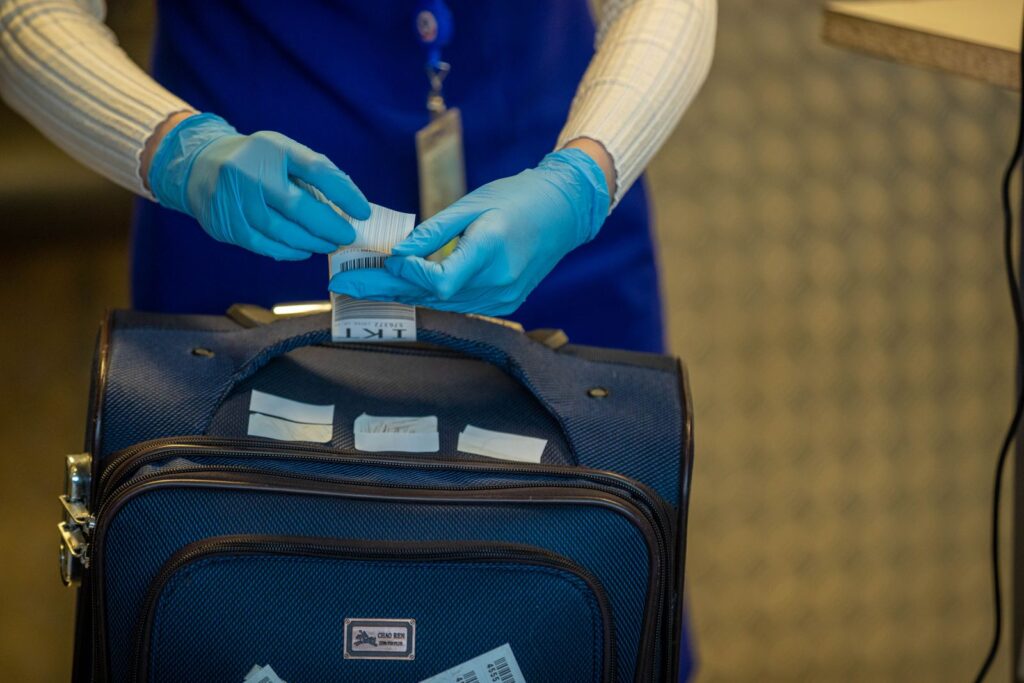
Yes, every checked bag goes through TSA screening. There is no exception and no opt out. The direct answer to does checked bags go through tsa is simple.
A machine sees inside every single bag before it reaches the aircraft.
That is true whether you fly a major airline or a small regional carrier. What varies is what happens after the scan, and that is the part most travelers actually want to know.
Here is the bag’s actual path. You hand it over at the counter or the self-service bag drop. An agent tags it, and it moves onto a belt system that TSA controls from that point forward.
It passes through an explosive detection machine. Most bags are cleared right there and loaded onto a cart bound for your aircraft.
A smaller share get pulled for a closer look. Only some of those are ever opened by hand.
Does checked bags go through TSA at every airport
Whether you fly a legacy carrier or a discount airline, does checked bags go through tsa is not an airline question. It is federal law, and it applies everywhere in the country, even at a small regional airport. The equipment and staffing differ by airport size, but the requirement does not.
What the screening machine actually does
The core of checked baggage screening is an explosive detection system, called an EDS. TSA’s own description of the technology says it uses computed tomography. That builds a three dimensional image of everything inside the bag.
Software then scans that image for the shape and density of explosives. It is the same basic idea as a medical CT scanner, aimed at a suitcase instead of a person.
TSA’s published fact sheet on its checked baggage inspection system puts the automatic clear rate at roughly 95 percent nationwide. No further review is needed for those bags. The system is fast by design.
A single airport’s setup can move well over a thousand bags an hour. Bags travel from the ticket counter, through screening, to the point where they load onto the plane. No person touches most of them along the way.
What triggers a manual review
When the EDS software flags something unclear, it forwards the image. A TSA officer reviews it from a screen elsewhere in the airport, and decides if it is a false alarm or if the bag needs another look.
Dense electronics, packed liquids, foil wrapped food, and tightly rolled clothing are common reasons a scan looks murky.
Most flagged bags get resolved this way, through a second automated pass or a remote image review. A person does not unzip your suitcase for this step. A physical, hands on search is the last resort, not the first one.
How often TSA physically opens a bag
TSA does not publish an exact national rate for hand searches alone. That number sits inside the smaller slice of bags that need any follow up at all.
What is documented is the setting. A hand search happens in view of a closed circuit camera, as a recorded step rather than a private one.
This is where does checked luggage get scanned and does checked luggage get physically opened start to diverge. Nearly every bag only ever gets scanned.
Only a fraction of that smaller group ever gets a hand search. TSA treats it as a monitored, documented event.
The notice of inspection: what it means and what it does not
If TSA opens your bag by hand, federal rule requires leaving a printed notice inside. It is commonly called a Notice of Inspection. Finding one means an officer searched the bag and resealed it, nothing more.
It is not a citation. It is not proof anything was found. It is not a sign you did something wrong.
A missing notice after a bag arrives damaged or disturbed points somewhere else entirely. Community reports describe rifled through bags with no notice inside.
Those cases tend to point toward baggage handling or theft, not a TSA search. TSA leaves that paper trail every single time it opens a bag.
Locks: what TSA can open, and what it cannot
TSA accepts a category of recognized locks. Its officers carry tools that open and reset those locks, so a flagged bag can be searched and relocked without cutting anything.
A lock outside that recognized list is a different story.
If your bag is pulled for a hand search and the lock cannot be opened with tools on hand, TSA cuts it off. That is where travelers actually lose money, not on the screening itself.
Frequent flyer forum threads add a detail official guidance leaves out. Travelers report recognized locks getting cut or damaged too, not just unrecognized ones.
A recognized lock lowers the odds of damage. It does not remove them.
A hard sided case with a built in combination lock is the more reliable choice for a locked bag. That design removes the loose padlock entirely.
Theft is a separate problem from screening
Items missing from a checked bag get lumped in with TSA screening in a lot of online complaints. They are not the same failure.
Screening means TSA looking at an image, or rarely, opening a bag on camera and leaving a notice. Theft means someone taking something with none of that documentation, anywhere from ramp worker to baggage claim.
See our page on bags that arrive damaged or missing items for how to file that kind of claim. It runs through the airline, not TSA.
The practical move is to keep anything valuable or irreplaceable out of a checked bag entirely. That holds regardless of who ends up responsible if it goes missing.
What TSA can take from a checked bag, and what happens to it
TSA’s own frequently asked questions page states plainly that there are no provisions for returning prohibited items removed from checked baggage. An officer who finds something that cannot legally fly in the hold keeps it. It does not come back later by mail or at a lost and found counter.
Hazardous materials found in a checked bag follow a slightly different path. TSA flags the item to your airline. The airline decides whether it is actually permitted, and TSA accepts that call.
Firearms, ammunition, and certain restricted items follow their own rules that go well beyond ordinary screening. The honest way around all of this is to check what you can pack before you get to the counter. Our page on items that are restricted or banned outright covers the details.
Our packing list screener checks a full bag list against current rules in a few seconds. That beats guessing at the counter.
Does screening delay your bag
For most bags, no. Screening is built into the normal time between check in and boarding. An automatic EDS clearance adds no meaningful delay.
A bag pulled for image review or a hand search takes longer to move through the system. In rare cases that can mean a missed tight connection.
TSA does not publish a guaranteed turnaround time for a flagged bag. Travelers with a short connection should treat that gap as a small, real risk, not a fixed number.
The bottom line
The short answer to does checked bags go through tsa screening never changes: every bag, every time. A CT based scanner clears about 95 percent of them automatically, by TSA’s own numbers, and the rest get a closer electronic look.
A small fraction of those get opened by hand, on camera, with a notice left behind. A recognized lock helps but is not a guarantee against damage. Pack anything irreplaceable in your carry-on instead.
Read our airport security screening guide and our full checked baggage guide before your next trip.
Common questions
Does TSA check checked baggage on every flight, including connections
Yes. Every checked bag is screened before its first flight.
A bag transferred at a connecting airport is usually handled under existing security clearance. Some international connections require a recheck.
Do they X-ray checked luggage the same way as carry-on bags
No. Checked bags go through a CT based system built into the baggage line. Carry-on bags go through the X-ray tunnel at the checkpoint instead.
Both build a detailed image, but the equipment is different.
Will TSA open my checked bag without telling me
If TSA physically searches your bag, it leaves a printed Notice of Inspection inside before resealing it. You will not get a call or text in the moment, but the notice tells you afterward.
Does TSA look through checked luggage for anything besides explosives
The EDS is built to detect explosives. An officer doing a hand search can and will flag other prohibited items too. Certain sharp objects, ammunition, and undeclared hazardous materials all count.
What happens if TSA finds something illegal in my checked bag
Prohibited items found in checked baggage are confiscated and are not returned. Hazardous materials get referred to your airline, which makes the final call on whether the item flies.
Can I lock my checked bag so TSA cannot see inside it
No. A lock does not stop TSA from screening a bag, since the scan happens without opening anything. A lock only affects whether TSA can get inside without cutting it during a hand search.
Some links on this page are Amazon affiliate links. If you buy through one, Carry On Sizes may earn a commission at no extra cost to you. It never changes what we recommend. How this works.