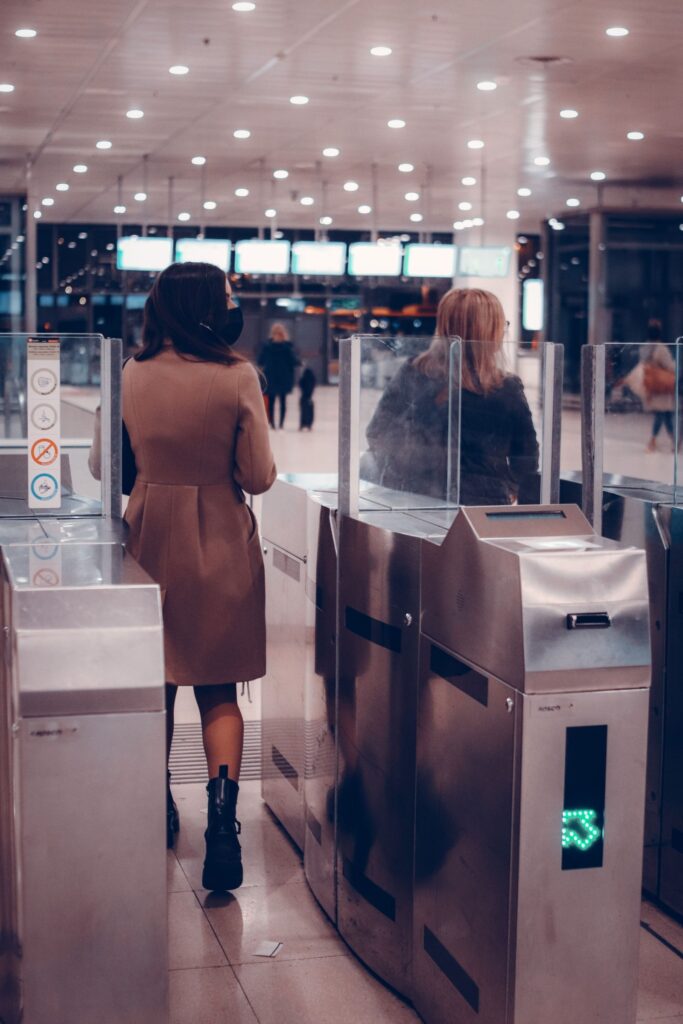
Can you go through TSA pregnant the same way as any other traveler? Yes. No rule pulls pregnant travelers out of the standard line.
No rule requires a doctor’s note, a due date on file, or advance notice to anyone. The checkpoint does offer a few choices that many travelers do not know they have. This page covers exactly what they are.
The short version: the millimeter wave scanner is the default option. A pat down is always available instead. Breast milk, formula, and juice travel outside the regular liquids rule.
None of that changes because you are pregnant. What changes is that more people ask about it once they are. The broader checkpoint basics are covered on the airport security page.
What the millimeter wave scanner actually emits
The scanner used at most US checkpoints is Advanced Imaging Technology, or AIT. It uses millimeter wave energy, not X-ray. According to the Transportation Security Administration, that energy is radiofrequency and does not ionize tissue.
TSA states the exposure runs about 1,000 times below the international limits set for this kind of energy. That is TSA’s own comparison, not an outside lab result. It is worth reading it that way.
For a rough sense of scale, a coast to coast flight also exposes a traveler to background cosmic radiation. Public health agencies have generally treated both exposures as small next to daily life. Neither TSA nor this page can tell you what feels right for your own pregnancy, and that call belongs to you and your doctor.
How to request a pat down instead
Can you go through TSA pregnant and still skip the scanner entirely? Yes. Every traveler can decline the scanner and ask for physical screening instead.
Say it before you step into the machine, not after. Tell the officer plainly that you want to opt out of AIT.
You do not need a reason. You do not need to mention that you are pregnant, though many travelers do just to speed things along. The officer then calls for a screening agent of the same gender.
That call is the main source of any delay. Expect a few extra minutes at a busy checkpoint. A quiet checkpoint with fewer agents on the floor can take longer.
What the pat down includes, and your privacy rights
A pat down is a physical check along the waistband, torso, and legs. A gloved officer of the same gender as the traveler performs it. Some travelers report a check inside the waistband of loose pants.
Clothing without a thick belt or a full elastic panel tends to move faster through this check. Every traveler can ask for the pat down to happen in a private room instead of in the open checkpoint area. You can also ask for a witness of your own choosing, such as a travel companion, to be present.
Neither request slows the process down by much. Officers are used to both.
| Option | What happens | Privacy |
|---|---|---|
| Millimeter wave scanner | Stand in the unit for a few seconds, no contact | Standard checkpoint area |
| Pat down | Physical check by an officer of the same gender | Checkpoint or a private room on request |
| Metal detector | Walk through, alarms only on metal | Standard checkpoint area |
The metal detector as a third option
A walk through metal detector is still in use at some lanes, especially PreCheck lanes. It works differently from the scanner. It detects metal only and does not image the body at all.
Whether a metal detector is available depends on the checkpoint and the lane, not on a traveler’s request. If your lane only has the millimeter wave unit, the pat down is your alternative. The general packing steps in carry-on rules still apply no matter which screening you choose.
Breast milk, formula, and juice at the checkpoint
Breast milk, formula, and juice for an infant or toddler are exempt from the standard rule covering liquids and gels. This has nothing to do with whether the traveler herself is pregnant. It applies to any caregiver carrying these items.
TSA does not set a hard ounce cap on these items the way it does for ordinary liquids. Instead it asks for an amount reasonable for the length of the trip. An officer decides that case by case.
These items do not need to fit in your quart bag with other liquids. Take them out of your carry-on and declare them to the officer before the belt. They get screened separately, typically by X-ray or a bottle scanner rather than by opening each container.
Planning the rest of your liquids around this exemption is easier with a tool built for it. Run your full list through the liquids packer before you leave. The broader rules for baby items are on the medical and baby category page.
Medication, cooling packs, and medical devices
Medication in liquid form, prescription or over the counter, is also exempt from the standard cap. Bring whatever quantity you need for the trip. Ice packs and gel packs used to keep formula or medication cold are allowed too, even partially frozen.
Medical devices such as a support belt or compression equipment do not require a doctor’s note. No paperwork is required at all. General tips on organizing everything you carry live on the packing page.
TSA’s own guidance on special procedures notes that a traveler may offer a notification card describing a condition. That card is optional, not a requirement for screening. Simply tell the officer what you are carrying and let them screen it.
What changes in a PreCheck lane
TSA PreCheck lets most travelers keep shoes, a light jacket, and a belt on. Laptops and small liquids can stay inside the bag. None of that changes for a pregnant traveler in the lane.
The scanning equipment in a PreCheck lane still varies by airport. Some lanes use the same millimeter wave scanner as the standard line rather than a metal detector alone. The right to decline that scanner and request a pat down applies in PreCheck exactly as it does everywhere else.
Can you go through TSA pregnant in a PreCheck lane the same way as the standard line? Yes, the same rights carry over.
Common questions
Can you go through TSA pregnant without telling anyone?
Yes. Nothing in the process requires you to disclose a pregnancy. No lane or scanner treats pregnant travelers differently by default.
Does opting out of the scanner take much longer?
Usually just a few extra minutes while an officer of the same gender is called over. At an understaffed checkpoint the wait can run longer, so build in some buffer time.
Is there a trimester when the scanner is not recommended?
TSA’s own materials set no trimester cutoff and no age limit for the scanner. Whether to use it at any stage of pregnancy is a personal decision. This page will not tell you what is safe for you specifically.
Do I need a doctor’s note for a medical device or medication?
No. Officers screen the item based on what you tell them, not on paperwork. A notification card is available if you prefer to hand one over.
How much breast milk or formula can I bring?
More than the standard 3.4 ounce limit, in an amount reasonable for your trip length. It travels outside your quart bag and gets declared and screened on its own.
Can I request a private room for a pat down even if I am not asked?
Yes. Any traveler can request a private screening room and a witness of their choosing before the pat down begins.
Some links on this page are Amazon affiliate links. If you buy through one, Carry On Sizes may earn a commission at no extra cost to you. It never changes what we recommend. How this works.